We add value twice: in every house, and across the portfolio.
A converted house is too small for an institution to own. Hundreds of them, standardised, licensed and run to one standard, are exactly what institutional buyers of residential income are looking for.

One family let becomes seven en-suite rooms.
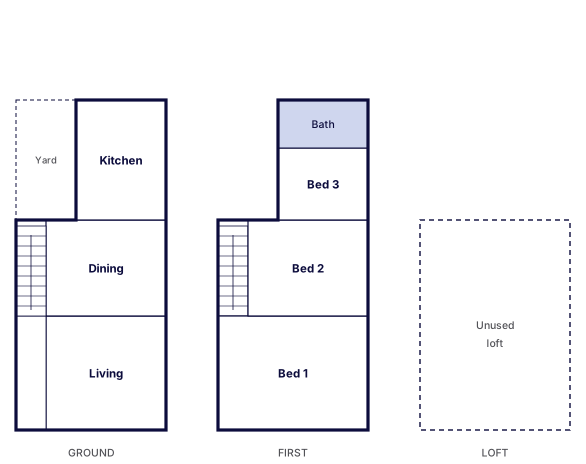
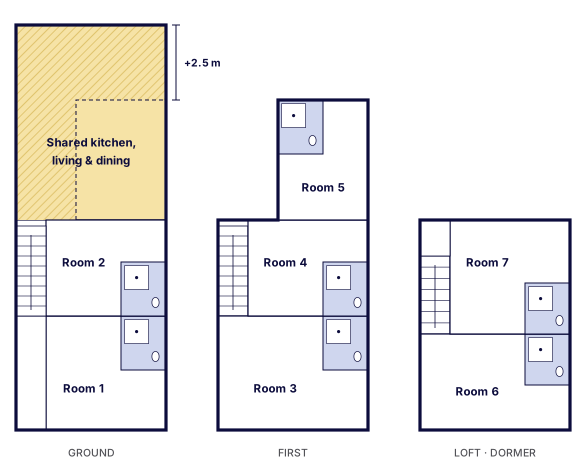
Seven private rooms, each with its own shower room.
The side return is infilled and the rear extended, creating one large shared kitchen, living and dining room.
A rear dormer adds two rooms in space that earned nothing before.
Shows how a conversion changes a house's layout and rent roll. Not to scale, not a forecast, and does not describe investor returns. Returns are available to qualifying investors →
Six steps, repeated house by house.
The same steps apply to every house, which is what turns individual conversions into one consistent portfolio.
- 01AcquireThree- and four-bed terraced and semi-detached houses in employment towns where demand for rooms runs well ahead of licensed supply, bought at prices that reflect their value as family lets, not as co-living homes.
- 02ConsentHMO planning consent and licensing secured for each house, so every home is lawful and licensed before it is let.
- 03ConvertEach house is extended, rewired, brought to a better energy rating and fitted with an en-suite for every bedroom, to one common specification.
- 04LetRooms are let to working professionals, with bills included, and the homes are run to one standard across the portfolio.
- 05Term outOnce the portfolio is let and stabilised, development finance is refinanced onto long-term mortgages against its income value.
- 06Hold and exitThe portfolio is held for income until our target price is achieved, then sold to an institutional owner of residential income.
Concentrated, not scattered.
We concentrate homes in a small number of towns. Density lowers the cost of building and running each home, and it makes the portfolio easier to sell: a buyer acquires a coherent, local operating business, not a scatter of unrelated houses.
Built from the start to be bought.
An institutional buyer pays for income it can trust and assets it does not have to fix. We build both into every home from day one.
Common specification, layouts and suppliers across every home, so the portfolio can be valued and run as one.
HMO licences, fire safety and Renters' Rights Act processes in place before a buyer's due diligence starts.
Every home upgraded during conversion, ahead of the proposed EPC C minimum for rented homes.
Rent, occupancy, arrears and maintenance history recorded for every room.
Term out, hold, and sell at our price.
The exit does not depend on a fixed sale date. Once the portfolio is stabilised it is refinanced onto long-term debt and held, earning income, until a buyer meets our target price.
Holding is not a waiting period. The portfolio pays its way through rental income, and rising rents create room to refinance again, so investors are rewarded while we wait for the right price.
- Stage 1 · StabilisationTerm outWhen homes are let and earning, short-term development finance is replaced with long-term mortgages, sized at up to 75% of the portfolio's income-based value. Because a converted, let house is valued on its rent, refinancing releases much of the equity invested.
- Stage 2 · HoldIncome and refinancingNet rent after interest is distributed to investors. In our base case, rent covers mortgage interest more than 1.3 times. As rents grow, the portfolio can be refinanced again.
- Stage 3 · ExitSale at our target priceThe stabilised portfolio is offered as one business to institutional owners of residential income, and sold when the price meets our target, not before.
Many small projects are safer than one large one.
Large developments concentrate planning, construction and market risk into a single outcome, often over several years. A portfolio of small conversions spreads those risks across dozens of independent projects, each lasting months.
A refusal or a slow build affects one house, not the programme, and every completed project improves the cost and timing of the next.
Better homes from the buildings we already have.
Converting existing houses avoids the carbon cost of demolition and new build. Each conversion improves insulation, heating and controls, and adds renewable energy where the building allows, so the homes are cheaper to run and ready for tighter energy rules.
Because bills are included in the rent, every efficiency gain shows up directly in operating margin.
For family offices, institutions and qualifying private investors.
The information memorandum, financial model and terms are held in a private data room for approved professional, certified high-net-worth and self-certified sophisticated investors.