Converting 250 of Britain's Victorian houses into a premium co-living portfolio.
Licensed, energy-efficient homes for working professionals in supply-constrained towns, let Walk-In-Walk-Out (WIWO) and run as one institutional-grade portfolio, held for income until a buyer meets our price.

Three forces are moving in our favour.
- iRents are outpacing prices.UK rents rose 3.8% in a year while house prices rose 0.9%,1 and room rents hit record highs in six of nine regions.2
- iiRegulation is pushing small landlords out.The Renters' Rights Act took effect in May 2026, a landlord register opens in December,5 and an EPC C minimum is proposed for 2030, when about half of rented homes fall short today.6
- iiiPlanning is limiting new supply.HMO refusals doubled between 2021 and 2025,3 and 75 to 80 councils now require full permission for small HMOs.4 Consented, licensed homes are becoming scarcer.
One family let becomes seven or eight en-suite rooms.
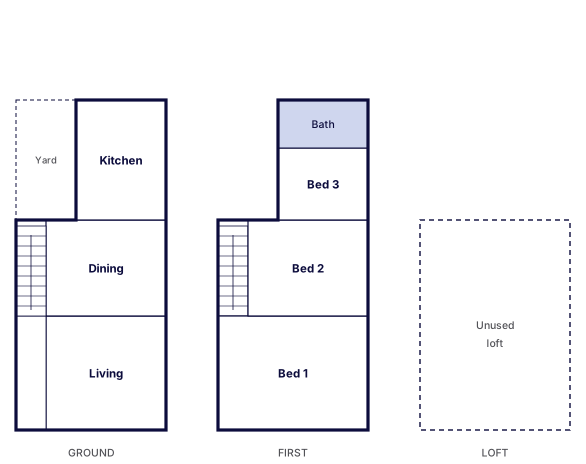
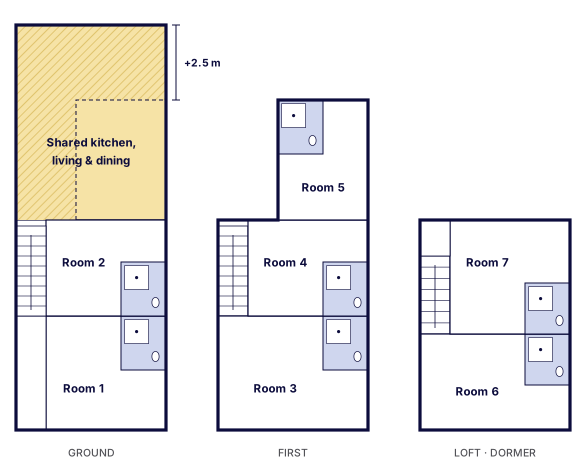
Seven private rooms in this three-bed example, each with its own shower room. Four-bed houses become eight.
The side return is infilled and the rear extended, creating one large shared kitchen, living and dining room.
A rear dormer adds two rooms in space that earned nothing before.
Shows how a conversion changes a house's layout and rent roll. Not to scale, not a forecast, and does not describe investor returns. Returns are available to qualifying investors →
From single houses to one institutional portfolio.
Individually, a converted house is too small for an institution to own. Hundreds of them, standardised, licensed and run to one standard, form a portfolio that institutions can buy. We create value at the asset level through conversion, and at the portfolio level through aggregation.
Many small projects carry less risk than one large one. A refusal or delay on any single site affects a small share of the portfolio, and lessons from each site feed into the next.

- 01AcquireThree- and four-bed houses in employment towns where demand for rooms outstrips licensed supply.
- 02ConsentHMO planning consent and licensing secured for every home.
- 03ConvertExtended and upgraded, with an en-suite for every bedroom, to one common specification.
- 04LetRooms let Walk-In-Walk-Out (WIWO) to working professionals: furnished, bills and broadband included, run to one standard.
- 05Term out and holdRefinanced onto long-term debt at stabilisation, held for income, and sold when our target price is achieved.
Read more: our strategy · our platform · conversions by our delivery team
Working professionals, renting for longer.
Our homes are let room by room to employed professionals in their twenties and thirties who want a private en-suite in a well-run home near work and transport. Every home is WIWO: furnished, with every bill and broadband included, so tenants have nothing to buy or set up. 43% of English households led by someone under 35 rent privately, and 49% expect it to take five years or more to buy a home.7
For the investor, income is spread across seven or eight tenancies per building, so a single void moves the rent roll by a fraction rather than to zero.
For family offices, institutions and qualifying private investors.
The information memorandum, financial model and terms are held in a private data room for approved professional, certified high-net-worth and self-certified sophisticated investors.